





Medically reviewed by Dr. Yury Slepak, DDS, Diplomate, American Board of Pediatric Dentistry | 20+ Years Experience | Last Updated: May 2026
If your child has lost a back baby tooth early because of a cavity, an injury, or a tooth that had to be pulled, your pediatric dentist may recommend a space maintainer. Many parents have never heard of these before that conversation. This guide explains exactly what space maintainers are, when kids need them, the different types, what care looks like, and what they cost. We will also link to the related AAPD guidance for parents who want to dig deeper.
What Is a Space Maintainer?
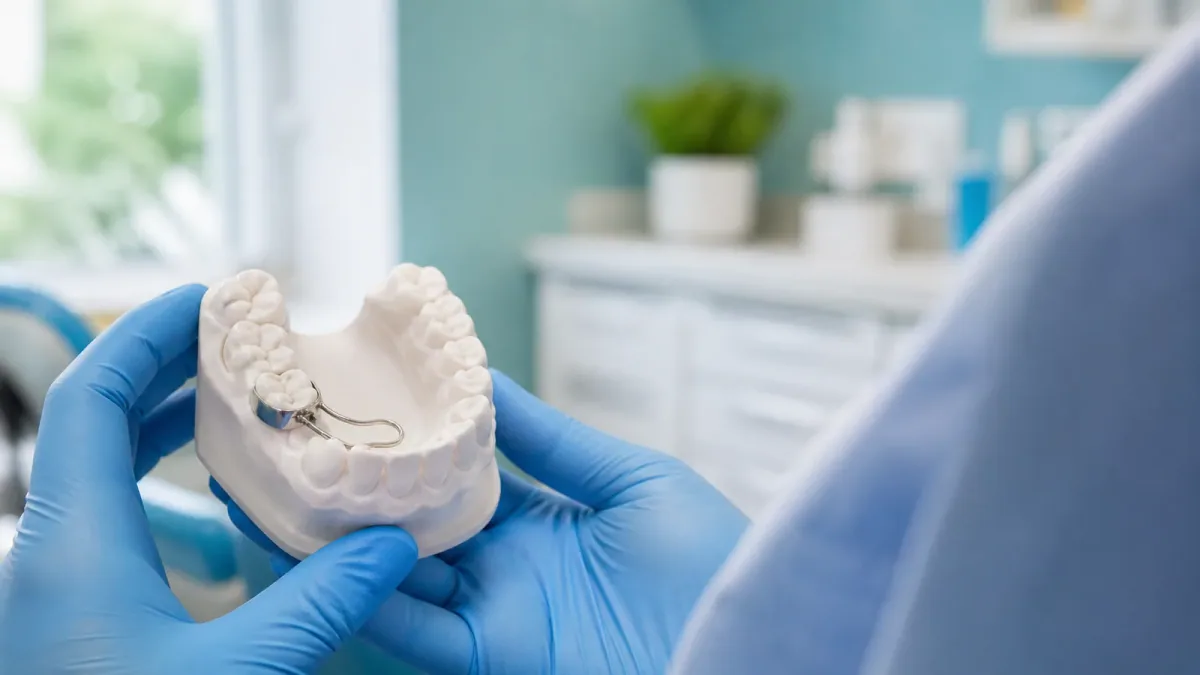
A space maintainer is a small custom dental appliance, usually made of stainless steel or acrylic, that holds the empty space where a baby tooth used to be. Its job is to keep the neighboring teeth from drifting into the gap while the permanent tooth grows in underneath. It does not move teeth like braces, and it does not fill the space with a fake tooth. It just preserves the position of the surrounding teeth until biology catches up.
Some space maintainers are fixed (cemented onto a tooth, the child cannot remove it) and some are removable (taken in and out for cleaning, like a small retainer). The choice depends on the child's age, which tooth was lost, how cooperative the child is, and how long the appliance needs to stay in.
When Does a Child Need a Space Maintainer?
A space maintainer is typically recommended when a baby tooth (especially a back molar) is lost significantly earlier than nature intended. Common situations include:
- Severe cavity that requires extraction. The most common reason. Untreated decay damages a baby molar beyond repair and the tooth has to be removed.
- Trauma. A fall, a sports injury, or a fight that knocks out a tooth or damages it badly.
- Congenitally missing teeth. Some children are born without certain baby or permanent teeth.
- Pulpotomy or pulp therapy that fails. A "baby root canal" that does not heal can lead to extraction.
- Orthodontic recommendation. Sometimes an orthodontist asks for a space maintainer as part of a Phase 1 plan.
Not every lost baby tooth needs a space maintainer. Front baby teeth that are lost early often do not need one because permanent teeth come in soon and the cosmetic-only nature of the space rarely affects long-term alignment. Back baby molars are the bigger concern.
Why Do Kids Need Space Maintainers?
Baby teeth do more than chew. Each baby tooth holds a specific spot in the dental arch for the permanent tooth that will replace it. When a baby molar is lost early, the molars on either side can drift forward or tilt into the gap. By the time the permanent tooth is ready to erupt, there may not be enough room.
What happens without a space maintainer can include:
- The permanent tooth erupts crooked or only partially erupts (impaction)
- The permanent tooth gets stuck under the gum and never comes through
- Crowding that requires more aggressive orthodontic treatment later
- Bite problems (crossbites, overbites) caused by drifted teeth
- Increased risk of extractions during future orthodontic treatment
Space maintainers are a relatively small investment that often prevents bigger orthodontic problems later. For a deeper dive on early bite-correction, see our guide on early orthodontic treatment.
Types of Space Maintainers
1. Band-and-Loop (Fixed)
The most common type. A small stainless-steel band is cemented onto a tooth next to the gap, with a wire loop extending across the empty space. Used most often when one back baby tooth has been lost. Cannot be removed by the child.
2. Crown-and-Loop (Fixed)
Similar to band-and-loop, but instead of a band, a stainless-steel crown is placed on a tooth that needs additional protection. Used when the anchor tooth itself has a large cavity or filling.
3. Distal Shoe (Fixed)
Used when a baby second molar is lost before the permanent first molar has erupted. A small extension goes below the gumline to guide the permanent first molar into the right place. Requires more clinical skill and follow-up.
4. Lingual Arch (Fixed, Bilateral)
Used when teeth are missing on both sides of the lower arch. A wire runs along the inside (tongue side) of the lower teeth, anchored to bands on the back molars.
5. Nance Appliance (Fixed, Upper Bilateral)
The upper-jaw equivalent of a lingual arch. Anchored on both upper molars with a small acrylic button resting on the roof of the mouth.
6. Removable Acrylic (Like a Retainer)
Looks like a small upper or lower retainer with a fake tooth or wire spacer. Used when a child is cooperative enough to keep it in. Removed for cleaning and at meals if instructed.
What to Expect at the Space Maintainer Appointment
- Exam and X-ray. The dentist confirms the gap and checks where the permanent tooth is in development.
- Fitting visit. A small impression or digital scan is taken so the lab can build the appliance to the exact dimensions of the gap. For some types, a band is sized to a neighboring tooth at this visit.
- Lab fabrication. The appliance is made (usually 1 to 2 weeks at a dental lab).
- Cementation. At a follow-up visit, the dentist cements the appliance into place. The whole appointment is usually 20 to 30 minutes for fixed types.
- Follow-up checks. Every 6 months at routine cleanings, plus an X-ray when the dentist thinks the permanent tooth is close to erupting.
How to Care for a Space Maintainer
- Brush around it carefully twice a day. Plaque can build up around the wire and band, so spend extra time on those spots.
- Floss the surrounding teeth. Use a floss threader if needed.
- Avoid sticky and chewy foods. Gum, taffy, caramel, sticky candy, and chewing on ice or pens can pull the appliance loose.
- Avoid biting hard foods directly with the appliance side. Hard pretzels, hard nuts, and ice are common culprits.
- Watch for loose appliances. If the band feels loose or the wire is poking, call the dentist. Do not wait. A loose appliance can be swallowed or misaligned.
- Keep all follow-up appointments. The dentist tracks the permanent tooth and removes the appliance at the right time.
How Long Does a Space Maintainer Stay In?
It depends on which baby tooth was lost and how soon the permanent tooth is expected. Some space maintainers stay in for a few months if the permanent tooth is close to coming in. Others stay in for 2 to 4 years if the baby tooth was lost very early. The dentist removes the appliance once the permanent tooth has clearly started to erupt.
How Much Do Space Maintainers Cost?
Cost varies by appliance type, lab, geographic area, and insurance coverage. Band-and-loop space maintainers are typically the lowest cost option. Bilateral appliances (lingual arch, Nance) and distal shoes are higher because they cover more teeth and require more lab work. Most dental insurance plans cover space maintainers, especially when a baby tooth has been lost due to extraction or trauma. Call your insurance provider or our office to verify your specific benefits and out-of-pocket cost.
How Bite Squad Dental of NYC Handles Space Maintainers
Dr. Yury Slepak is a Diplomate of the American Board of Pediatric Dentistry with 20+ years of experience placing space maintainers for Brooklyn kids. We use modern digital impressions when possible to reduce chair time, and we help parents understand exactly which type of maintainer their child needs and why. We also coordinate with orthodontists when a Phase 1 plan is in play. For related reading, see our guide on when a baby tooth should come out.
Pediatric Space Maintainers Near You in Brooklyn, NY
Bite Squad Dental of NYC is at 2464 Coney Island Avenue, Brooklyn, NY 11223 and serves families across Sheepshead Bay (11235), Brighton Beach, Coney Island, Gravesend, Bensonhurst, Midwood, Flatbush, Borough Park, Canarsie, and Bay Ridge. We see kids who have lost a baby molar early and need a fitted appliance to preserve the gap until the permanent tooth comes in.
If you are searching for "space maintainers near me", "pediatric space maintainer Brooklyn", or your dentist has just told you your child needs one and you want a second opinion, call 718-998-2424 or request an appointment online.
Frequently Asked Questions
What is a space maintainer for kids?
A space maintainer is a small custom dental appliance that holds open the gap left when a child loses a baby tooth too early. It keeps the neighboring teeth from drifting into the empty space so the permanent tooth has room to erupt correctly. Most space maintainers are made of stainless steel and stay in for several months to a few years until the permanent tooth comes in.
When does a child need a space maintainer?
A space maintainer is typically recommended when a baby molar is lost significantly earlier than nature intended due to severe cavities requiring extraction, trauma, congenitally missing teeth, failed pulp therapy, or as part of an orthodontic plan. Front baby teeth that are lost early often do not need one. Your pediatric dentist makes the call based on which tooth was lost and the position of the permanent tooth underneath.
How long does a space maintainer stay in?
It depends on which baby tooth was lost. Some maintainers stay in for a few months if the permanent tooth is close to erupting. Others stay in for 2 to 4 years if the baby tooth was lost very early. The dentist removes the appliance once the permanent tooth has clearly begun to erupt.
Are space maintainers covered by dental insurance?
Most dental insurance plans cover space maintainers, especially when a baby tooth has been lost due to extraction or trauma. Coverage varies by plan. Call your insurance provider or our office to verify your specific benefits and out-of-pocket cost.
Does a space maintainer hurt?
The fitting and cementation process is generally painless. Some children feel mild pressure or awkwardness for the first day or two as they adjust to the appliance in their mouth. After that, most kids forget it is there.
Where can I find a pediatric dentist for space maintainers in Brooklyn?
Bite Squad Dental of NYC at 2464 Coney Island Avenue, Brooklyn, NY 11223 is a board-certified pediatric practice that places fixed and removable space maintainers for kids across Sheepshead Bay, Brighton Beach, Coney Island, Gravesend, Bensonhurst, Midwood, Flatbush, Borough Park, Canarsie, and Bay Ridge. Call 718-998-2424 or book online.
About the Author
Dr. Yury Slepak is a board-certified pediatric dentist (Diplomate, American Board of Pediatric Dentistry) at Bite Squad Dental of NYC in Brooklyn. With over 20 years of experience caring for kids, he places space maintainers as part of preserving the natural eruption pattern of permanent teeth. He is a member of the American Academy of Pediatric Dentistry and the American Dental Association.