






Medically reviewed by Dr. Yury Slepak, DDS, Diplomate, American Board of Pediatric Dentistry | 20+ Years Experience | Last Updated: May 2026
Almost every parent asks some version of this question at the first dental visit: are dental X-rays really safe for my child? It is a fair question. Concerns about radiation exposure in childhood are well documented in medicine. The honest answer is that with today's digital sensors, lead aprons, thyroid collars, and ALARA protocols, the radiation dose from a single pediatric dental X-ray is very small, and the diagnostic value (catching cavities between teeth, monitoring permanent-tooth development, finding infections early) outweighs the risk for most children. This guide explains exactly how it works.
How Much Radiation Is in a Pediatric Dental X-Ray?
Modern digital dental X-rays use a small digital sensor instead of film. Digital sensors are far more sensitive than film, which means much less radiation is needed to capture the image. According to the American Dental Association, a single digital bitewing X-ray produces about 0.005 millisieverts (mSv) of radiation, comparable to less than a day of natural background radiation that everyone is exposed to from the environment.
For context, common comparison points include:
- Background radiation per day (everyone): around 0.008 mSv
- One digital dental bitewing X-ray: around 0.005 mSv
- One round-trip cross-country flight: around 0.04 mSv
- One chest X-ray: around 0.1 mSv
- One CT head scan: around 2 mSv
The key point: a routine pediatric dental X-ray is a tiny fraction of medical radiation people are exposed to every year, and a fraction of natural background radiation. Modern equipment makes it lower than it used to be in the film era.
The Safety Protocols Every Pediatric Office Should Use
1. Digital Sensors (Not Film)
Digital dental sensors require significantly less radiation than traditional film. If your dentist still uses film, ask why. Most reputable pediatric offices have moved to digital.
2. Lead Apron and Thyroid Collar
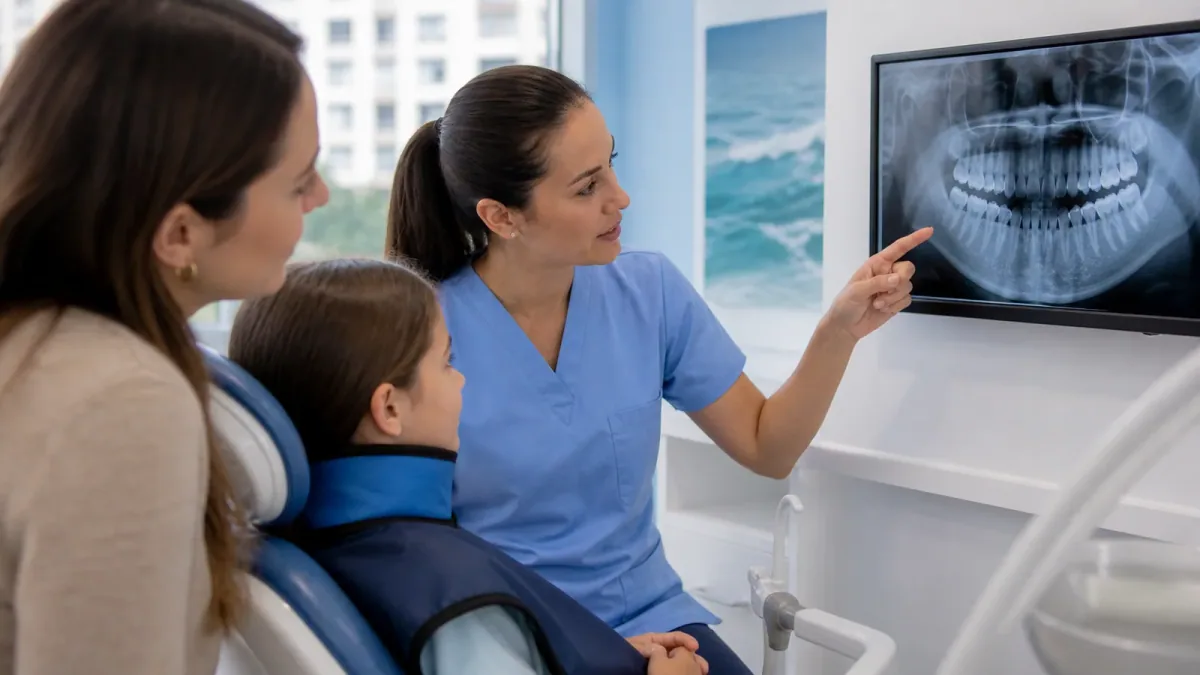
A lead apron protects your child's torso and reproductive organs from scatter radiation. A thyroid collar (the small flap that wraps around the neck) is critical for kids because the thyroid gland is more sensitive to radiation in childhood. The AAPD recommends thyroid collars for all pediatric X-rays. If the office takes an X-ray without a thyroid collar on a child, ask why.
3. ALARA Principle (As Low As Reasonably Achievable)
This is the radiation safety standard followed in medicine and dentistry. It means using the minimum radiation needed to get a diagnostic image and only taking X-rays when there is a clear reason. ALARA is the reason your dentist does not just take a full mouth series at every visit.
4. The "Image Gently" Alliance
"Image Gently" is an alliance of medical and dental societies committed to lowering radiation exposure in pediatric imaging. Many pediatric dental offices, including ours, follow Image Gently guidelines. You can ask if your office is a member or follows the principles.
How Often Should Children Get Dental X-Rays?
There is no fixed schedule. The American Academy of Pediatric Dentistry recommends X-ray frequency be tailored to each child's individual cavity risk, age, and dental history. The AAPD's general guidelines look something like this:
- Children with low cavity risk: bitewing X-rays every 12 to 24 months
- Children with high cavity risk: bitewing X-rays every 6 to 12 months
- Panoramic or full-mouth X-rays: taken less frequently, typically only when needed for specific evaluation (jaw growth, impacted teeth, ortho planning, trauma)
The dentist makes this judgment based on your child's exam, cavity history, oral hygiene, and family dental history. If your child has had no cavities and good oral hygiene, X-rays will be less frequent than for a child with multiple cavities.
What Do Pediatric Dental X-Rays Actually Look For?
- Cavities between teeth (the only way to see these, since you cannot see them visually)
- Cavities under fillings or in early stages
- Permanent teeth developing under baby teeth
- Missing or extra permanent teeth
- Impacted teeth (teeth that are stuck and not coming in properly)
- Bone-level changes from infection or gum problems
- Tooth-root injuries after trauma
- Jaw or sinus issues visible on a panoramic X-ray
Many of these problems cannot be detected without an X-ray. Skipping X-rays entirely means relying only on visual exam, which misses problems that develop between teeth or below the gumline.
When Should a Child Get Their First Dental X-Ray?
There is no fixed first-X-ray age. The first X-ray is typically taken when the dentist needs to see something specific, often when the back baby teeth are touching each other (around age 4 to 6) and visual exam can no longer rule out cavities between them. Children with high cavity risk or who have had trauma may have X-rays earlier; children with low risk may not need their first X-ray until later. The American Academy of Pediatric Dentistry leaves the timing to the individual dentist's judgment.
What If My Child Cannot Sit Still for an X-Ray?
This is common, especially for younger children, anxious children, or children with sensory differences. Options include:
- Skipping the X-ray for now and trying again at the next visit
- Using a smaller pediatric-sized sensor
- Having the parent in the room for support
- Using a panoramic X-ray (no sensor in the mouth)
- Using "tell-show-do" desensitization
- Coming back another day for X-rays alone
A good pediatric office will not force an X-ray on a child who is not ready. If your child is upset, the dentist should pause and try again later.
How Bite Squad Dental of NYC Handles Pediatric X-Rays
At Bite Squad Dental of NYC, we use modern digital dental sensors that require lower radiation than film, every child wears a lead apron and thyroid collar, and we follow ALARA principles: only the X-rays needed for diagnosis, only as often as your child's individual cavity risk requires.
Dr. Yury Slepak is a Diplomate of the American Board of Pediatric Dentistry with 20+ years of experience caring for kids in Brooklyn. We are happy to walk you through exactly what an X-ray is for before any image is taken, and we never push a parent who has concerns. If your child is anxious or has sensory differences, see our guide on special-needs pediatric dental care.
Pediatric Dental X-Rays Near You in Brooklyn, NY
Bite Squad Dental of NYC is at 2464 Coney Island Avenue, Brooklyn, NY 11223 and serves families across Sheepshead Bay (11235), Brighton Beach, Coney Island, Gravesend, Bensonhurst, Midwood, Flatbush, Borough Park, Canarsie, and Bay Ridge. We use digital pediatric X-ray equipment with lead aprons and thyroid collars on every child.
If you are searching for "children's dental x-rays near me" or have questions about X-ray safety before your child's next visit, call 718-998-2424 or request an appointment online.
Frequently Asked Questions
Are dental X-rays safe for kids?
Yes. With modern digital equipment, lead aprons, thyroid collars, and the ALARA principle, the radiation dose from a routine pediatric dental X-ray is very low and considered safe by the American Academy of Pediatric Dentistry and the American Dental Association. The diagnostic value of finding cavities and monitoring tooth development outweighs the small radiation exposure for most children.
How often does my child need dental X-rays?
It depends on your child's individual cavity risk. Children with low cavity risk typically need bitewing X-rays every 12 to 24 months. Children with high cavity risk may need them every 6 to 12 months. There is no fixed schedule, and your dentist makes this judgment based on your child's exam and history.
What is a thyroid collar and does my child need one?
A thyroid collar is a small lead flap that wraps around the neck to protect the thyroid gland from scatter radiation. The American Academy of Pediatric Dentistry recommends thyroid collars for all pediatric dental X-rays. If an office takes an X-ray on a child without a thyroid collar, ask why.
What is the difference between a bitewing and a panoramic X-ray?
A bitewing X-ray shows the back teeth from above and below in one image, used to find cavities between teeth. A panoramic X-ray takes a single image of the entire upper and lower jaw and is used to evaluate jaw development, impacted teeth, and orthodontic planning. Bitewings are more common at routine cleanings; panoramics are taken less often.
Can I refuse dental X-rays for my child?
Yes, parents can decline X-rays. Your dentist should explain what the X-ray is for and what the diagnostic risk is of skipping it. Sometimes skipping a single X-ray at one visit is reasonable; long-term, regular X-rays are part of standard pediatric dental care because they catch problems that visual exam cannot.
Where can I find a pediatric dentist for safe digital X-rays in Brooklyn?
Bite Squad Dental of NYC at 2464 Coney Island Avenue, Brooklyn, NY 11223 uses digital pediatric X-ray equipment, lead aprons, and thyroid collars on every child, following ALARA radiation safety principles. Call 718-998-2424 or book online.
About the Author
Dr. Yury Slepak is a board-certified pediatric dentist (Diplomate, American Board of Pediatric Dentistry) at Bite Squad Dental of NYC in Brooklyn. With over 20 years of experience caring for kids and teens, he uses modern digital X-ray equipment and follows ALARA radiation safety principles. He is a member of the American Academy of Pediatric Dentistry and the American Dental Association.