





Medically reviewed by Dr. Yury Slepak, DDS, Diplomate, American Board of Pediatric Dentistry | 20+ Years Experience | Last Updated: May 2026
Finding a pediatric dentist who actually knows how to care for a child with special needs is one of the hardest parts of being a special-needs parent. Most general and family dentists do not have specialty training for sensory accommodations, sedation, or hospital-level cases. Many parents try several offices before finding one that works. This guide explains what makes a special-needs pediatric dentist different, what to ask before booking, and what care looks like at every level from a routine cleaning to a hospital procedure.
What Is a Special-Needs Pediatric Dentist?
A special-needs pediatric dentist is a pediatric specialist (Diplomate of the American Board of Pediatric Dentistry) whose residency training included children and patients with disabilities, sensory differences, behavioral challenges, and medical complexity. The American Academy of Pediatric Dentistry (AAPD) explicitly defines pediatric dentistry as the specialty for “infants, children, adolescents, and patients with special health care needs.” So in theory, every board-certified pediatric dentist is trained for special-needs care, but in practice, the depth of accommodation varies a lot from office to office.
The key differences in a true special-needs-friendly office are:
- Time: Appointments are longer (often 60 to 90 minutes instead of 30) so the team can move at the child’s pace.
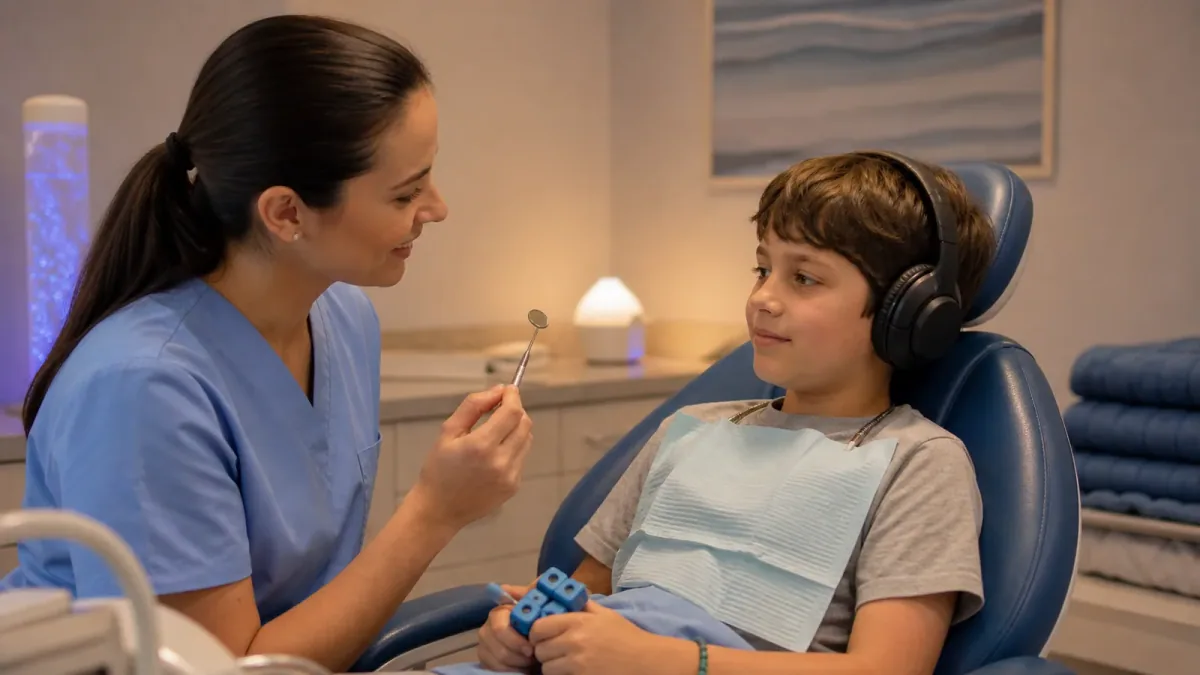
- Environment: Quieter, dimmer, with sensory tools available (noise-cancelling headphones, weighted blankets, calming visuals).
- Behavior management: Tell-show-do, social stories, desensitization visits, video previews, parent in the room.
- Sedation options: Nitrous oxide (“laughing gas”), oral conscious sedation, IV sedation, or general anesthesia, depending on the case.
- Hospital privileges: For the most complex cases, the dentist can take the child to a hospital operating room and complete dental work safely under general anesthesia by an anesthesiologist.
- Communication: Visual schedules, picture cards, AAC devices supported, parent included in every step.
What Conditions Are Considered “Special Needs” in Pediatric Dentistry?
“Special needs” in pediatric dentistry is broad. Common reasons families seek a specialist include:
- Autism spectrum disorder (ASD) with sensory or communication differences
- ADHD with difficulty staying still or focused during procedures
- Anxiety disorders or phobia of dental settings (sometimes called “dental phobia”)
- Down syndrome and other genetic syndromes
- Cerebral palsy and other movement or muscle-tone disorders
- Hearing or visual impairment
- Medical complexity: congenital heart conditions, bleeding disorders, immunocompromise, organ transplant history, cancer treatment
- Developmental delay or cognitive differences
- Severe behavioral challenges that make a routine cleaning impossible without accommodation
The right office should be honest with you about which of these they handle in-office and which they refer out. Not every special-needs case can be done in a routine clinic, and that is fine. The honest answer is what you want.
The 3 Levels of Special-Needs Pediatric Dental Care
Level 1: In-Office Routine Care With Accommodations
Most special-needs children can have routine cleanings, exams, and fluoride done in a regular pediatric dental chair if the office is set up for it. Accommodations typically include extra time, a quiet room, parent in the room, sensory tools, visual schedules, and a slow-paced “tell-show-do” approach. This works for many children with autism, ADHD, mild anxiety, or developmental delay.
Level 2: In-Office Care With Sedation
For children who cannot tolerate routine care even with accommodations (very young children, severe anxiety, sensory overload, longer procedures), in-office sedation is the next step. Options include:
- Nitrous oxide (“laughing gas”): minimal sedation, child stays awake, wears off in minutes after the visit
- Oral conscious sedation: a prescribed liquid medication taken before the appointment, child is drowsy but responsive
- IV sedation: deeper sedation, used selectively, requires specialized monitoring
The decision about sedation depends on the procedure, the child’s health history, and the dentist’s training.
Level 3: Hospital Operating Room Under General Anesthesia
For the most complex cases, where in-office care is not safe or feasible (severe medical complexity, very young, multiple procedures needed, severe anxiety after multiple failed attempts), the dentist takes the child to a hospital. The child is asleep under general anesthesia administered by a hospital anesthesiologist, and the dentist completes all needed work in one visit. This is the safest path for the most complex cases. Only pediatric dentists with hospital privileges can offer this.
For more on hospital-grade care, see our guide on hospital-grade pediatric sedation dentistry.
What to Ask a Special-Needs Pediatric Dentist Before Booking
- Is the dentist a board-certified pediatric specialist (Diplomate of the ABPD)?
- How much experience do you have with my child’s specific diagnosis (autism, ADHD, Down syndrome, etc.)?
- Do you offer extended appointments (60 minutes or longer) for special-needs visits?
- Do you do desensitization visits before the first cleaning?
- What sensory accommodations do you have on hand?
- Do you offer nitrous oxide, oral sedation, IV sedation? Which ones in-office?
- Do you have hospital privileges for cases that need general anesthesia?
- Are parents allowed in the operatory during treatment?
- How do you communicate with non-verbal children?
- Do you accept Medicaid or other insurance commonly used for special-needs care?
- How do you coordinate with my child’s pediatrician, OT, ABA team, or specialist?
How to Prepare Your Child for a Special-Needs Dental Visit
- Schedule a desensitization visit first. A short “happy visit” where the child meets the team, sits in the chair, and goes home without treatment.
- Use a social story. A simple sequence of pictures showing what will happen, in order, ahead of time.
- Bring familiar items. A weighted blanket, fidget, sensory toy, or favorite stuffed animal.
- Time the appointment well. Pick a time of day when your child is regulated, fed, and not over-tired.
- Bring a list of triggers. Sounds, lights, words, or movements that overwhelm your child. Share it before the visit.
- Bring the child’s communication tools. AAC device, picture cards, or whatever your child uses at school.
- Skip the surprise. Tell your child what is happening in advance using language and visuals they understand.
How Bite Squad Dental of NYC Handles Special-Needs Care
Dr. Yury Slepak is a Diplomate of the American Board of Pediatric Dentistry with 20+ years of experience caring for children with special needs in Brooklyn. Dr. Slepak holds hospital privileges at three medical facilities, which means children who need general anesthesia for complex dental work can have it safely in a hospital operating room.
Our office offers:
- Extended-time appointments for desensitization and special-needs visits
- Quiet operatories and parent-in-room policy
- Tell-show-do behavior management
- Nitrous oxide (“laughing gas”) for mild anxiety
- Hospital escalation for complex cases (general anesthesia at three Brooklyn and Queens medical facilities)
- Coordination with the child’s pediatrician and care team
- An ocean and fish-themed office that many sensory-sensitive kids find calming
Dr. Slepak completed his pediatric residency at Maimonides Medical Center and graduated with honors from NYU College of Dentistry. He is a member of the American Academy of Pediatric Dentistry and the American Dental Association.
Special-Needs Pediatric Dentist Near You in Brooklyn, NY
Bite Squad Dental of NYC is at 2464 Coney Island Avenue, Brooklyn, NY 11223 and serves families across Sheepshead Bay (11235), Brighton Beach, Coney Island, Gravesend, Bensonhurst, Midwood, Flatbush, Borough Park, Canarsie, and Bay Ridge. We see families from across Brooklyn, Queens, and Staten Island who need a pediatric dentist trained for autism, ADHD, sensory processing differences, Down syndrome, and other special-needs care.
If you are searching for a “special needs pediatric dentist near me”, “autism dentist Brooklyn”, “dentist for kids with special needs”, or “pediatric dentist for special needs children”, call 718-998-2424 or request an appointment online. We can do a quick phone intake before scheduling so the visit is set up properly the first time.
Frequently Asked Questions
What is a special-needs pediatric dentist?
A special-needs pediatric dentist is a board-certified pediatric specialist (Diplomate, American Board of Pediatric Dentistry) who treats children with autism, ADHD, sensory differences, Down syndrome, cerebral palsy, anxiety, or medical complexity. Their training, environment, and time-per-appointment are set up for these families.
Are dentists who work with special-needs kids different from regular pediatric dentists?
All pediatric dentists complete some training on special-needs care during residency, but in practice the depth of accommodation varies. The right office offers longer appointments, sensory accommodations, multiple sedation options, and (for complex cases) hospital privileges. Some pediatric dentists market themselves as special-needs specialists because they have invested heavily in this part of their practice.
How do I prepare an autistic child for a dental visit?
Schedule a desensitization “happy visit” first, use a social story to walk through what will happen, bring familiar sensory items, schedule the appointment at a time of day when your child is regulated, and share a list of triggers with the office before the visit. Bring your child's communication tools (AAC device, picture cards) so the team can use them during care.
Will my insurance cover special-needs dental care?
Most dental insurance plans cover routine and emergency dental care for special-needs children the same way they cover any other patient. Sedation, hospital fees, and anesthesia are sometimes covered, sometimes not, depending on medical necessity documentation. Medicaid often covers special-needs sedation and hospital dental cases when documented properly. Call our office to verify your specific benefits.
What if my child has had a bad experience at a previous dentist?
Tell us before the visit. Many of our families come to us after one or more failed appointments at general practices. We start with a desensitization visit, no treatment, and rebuild trust before any dental work. Some children need 2 or 3 visits before they are ready for a cleaning, and that is fine.
Where can I find a special-needs pediatric dentist in Brooklyn?
Bite Squad Dental of NYC at 2464 Coney Island Avenue, Brooklyn, NY 11223 offers special-needs pediatric care across all three levels (in-office with accommodations, in-office with sedation, hospital under general anesthesia). Call 718-998-2424 or book online.
About the Author
Dr. Yury Slepak is a board-certified pediatric dentist (Diplomate, American Board of Pediatric Dentistry) at Bite Squad Dental of NYC in Brooklyn. With over 20 years of experience caring for children with special needs, he holds hospital privileges at three medical facilities and is a member of the American Academy of Pediatric Dentistry and the American Dental Association.