
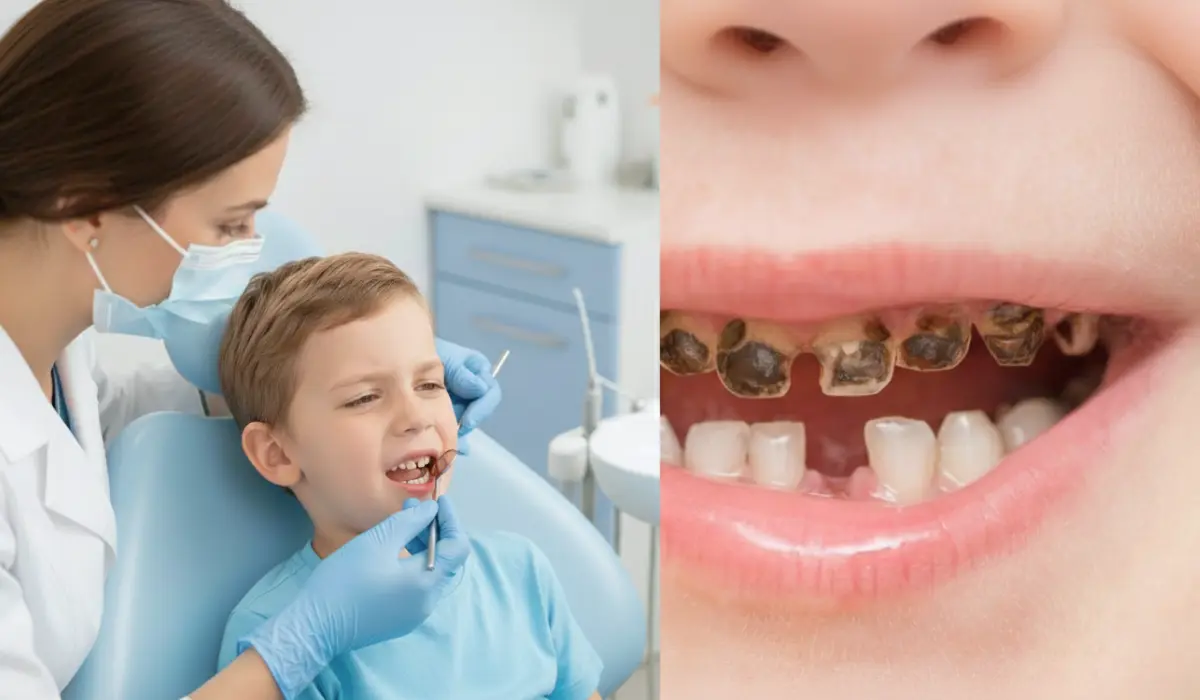
The most common signs of cavities in children include visible white or brown spots on teeth, sensitivity to hot, cold, or sweet foods, pain when chewing, and complaints of toothaches. If your child shows any of these signs, schedule a dental appointment promptly because early cavities can often be treated quickly and painlessly before they become serious problems.
Cavities are one of the most common childhood health issues, affecting more than half of all children by age 8. The good news is that cavities are preventable and treatable, especially when caught early. Knowing what to look for helps you act fast and protect your child’s smile.
What Does a Cavity Look Like on a Child’s Tooth?
Cavities change in appearance as they progress, so knowing the stages can help you catch them early.
- Early stage cavities often appear as chalky white spots near the gumline. These white spots indicate that minerals are being lost from the tooth enamel, a process called demineralization. At this stage, the cavity has not yet formed a hole, and it may be possible to reverse the damage with fluoride treatment and improved oral hygiene.
- Developing cavities begin to change color. The white spots may turn light yellow or light brown as decay progresses. You might notice these discolored areas on the chewing surfaces of molars or between teeth.
- Advanced cavities appear as dark brown or black spots. At this stage, a visible hole or pit has formed in the tooth. The decay has broken through the enamel and is now affecting the softer layer underneath called dentin.
Cavities most commonly form on the chewing surfaces of back teeth where food can get trapped in the grooves, between teeth where brushing and flossing may miss, and near the gumline where plaque tends to build up.
Early Warning Signs Your Child May Have a Cavity
Children cannot always tell you when something is wrong with their teeth. Watch for these warning signs that may indicate a cavity is developing.
- Tooth sensitivity is often one of the first signs. Your child may complain that certain foods or drinks hurt their teeth, particularly items that are hot, cold, or sweet. When enamel wears down, the sensitive layer underneath becomes exposed.
- Pain when biting or chewing can indicate that decay has progressed deeper into the tooth. Your child may favor one side of their mouth when eating or avoid certain foods altogether.
- Visible spots or discoloration on the teeth should always be evaluated. Any new white, yellow, brown, or black spots could indicate decay forming.
- Persistent bad breath that does not improve with brushing may be a sign of cavities or other dental issues. Bacteria that cause decay also produce odors.
- Complaints of toothache are a classic sign. The pain may come and go at first but typically becomes more constant as the cavity grows. Some children cannot pinpoint exactly which tooth hurts, just that their mouth is bothering them.
- Swelling around a tooth or along the gumline can indicate that decay has led to infection. This requires prompt dental attention.
It is important to note that not all cavities cause pain, especially in the early stages. This is why regular dental checkups are essential for catching cavities before your child even notices them.
Why Do Children Get Cavities So Easily?
Children are more prone to cavities than adults for several reasons. Understanding these factors can help you better protect your child’s teeth.
- Baby teeth have thinner enamel than permanent teeth. This protective outer layer is easier for acid and bacteria to penetrate, allowing decay to progress more quickly.
- Children’s diets often contain more sugar from juice, snacks, and treats. When bacteria in the mouth feed on sugar, they produce acid that attacks tooth enamel. Frequent snacking throughout the day means teeth are constantly exposed to these acid attacks.
- Brushing skills are still developing. Young children lack the coordination to thoroughly clean all surfaces of their teeth. Back molars with their grooves and crevices are especially difficult for small hands to reach properly.
- Certain habits increase cavity risk. Falling asleep with a bottle of milk or juice, frequent sipping from sippy cups, and grazing on snacks throughout the day all contribute to cavity formation.
Some children naturally have more cavity-causing bacteria in their mouths than others, making them more susceptible even with good hygiene habits.
Can Cavities in Baby Teeth Affect Permanent Teeth?
Many parents wonder whether cavities in baby teeth really matter since those teeth will eventually fall out. The answer is yes, baby tooth cavities can affect your child’s long-term oral health.
- Infection can spread to developing permanent teeth. The permanent teeth are forming in the jawbone directly beneath the baby teeth. Severe decay or infection in a baby tooth can damage the permanent tooth waiting to emerge.
- Early tooth loss affects spacing. Baby teeth hold space for the permanent teeth coming in behind them. If a baby tooth is lost too early due to decay, neighboring teeth may shift into the gap. This can cause crowding and alignment problems when permanent teeth try to come in.
- Cavities cause pain and difficulty eating. Untreated decay can make it hard for your child to chew properly, affecting their nutrition. Dental pain can also disrupt sleep and concentration at school.
- Oral health habits are established early. Children who experience dental problems may develop anxiety about dentist visits, making future care more difficult.
For all these reasons, treating cavities in baby teeth is important even though the teeth are temporary.
What Happens If a Cavity Goes Untreated?
When cavities are left untreated, they continue to grow and can lead to more serious problems.
In the early stages, a small cavity may cause occasional sensitivity. As decay progresses, the cavity grows larger and deeper. What could have been fixed with a simple filling may now require more extensive treatment.
If decay reaches the pulp, the soft tissue inside the tooth containing nerves and blood vessels, your child may experience significant pain. At this point, a pulp treatment (similar to a root canal for baby teeth) may be necessary to save the tooth.
When infection develops, an abscess can form. Signs of a dental abscess include severe pain, swelling in the face or jaw, fever, and a bad taste in the mouth. This is a dental emergency requiring immediate care.
In severe cases, the tooth may need to be extracted. Early tooth loss can then lead to spacing and alignment issues as described above.
The key takeaway is that small cavities are much easier and less expensive to treat than large ones. Regular dental checkups help catch problems early.
How Are Cavities Treated in Children?
Treatment depends on the size and location of the cavity and how much the decay has progressed.
- Fluoride treatments may be able to reverse very early cavities that have not yet formed a hole. The fluoride helps remineralize the weakened enamel.
- Tooth-colored fillings are used for small to moderate cavities. At Bite Squad Dental, we use composite resin that blends naturally with your child’s tooth. “The process is painless,” explains Dr. Yury Slepak, board-certified pediatric dentist. “We use numbing gels, gentle techniques, and distraction methods like storytelling to keep children comfortable.”
- Dental crowns may be recommended for teeth with extensive decay. These caps cover and protect the remaining tooth structure. For children, stainless steel crowns are often used on back teeth, while tooth-colored options are available for front teeth.
- Pulp therapy is necessary when decay reaches the nerve of the tooth. This procedure removes the infected tissue and preserves the tooth so it can remain in place until it naturally falls out.
- Extraction is a last resort when a tooth cannot be saved. If a baby tooth must be removed early, a space maintainer may be placed to hold the spot for the permanent tooth.
For children who are anxious or need extensive work, sedation options including laughing gas or hospital-based general anesthesia may be available to ensure a comfortable experience.
How to Prevent Cavities in Your Child’s Teeth
Prevention is always better than treatment. These habits can significantly reduce your child’s cavity risk.
- Brush twice daily with fluoride toothpaste. Use a rice-sized amount for children under 3 and a pea-sized amount for children 3 and older. Help your child brush until they have the coordination to do it thoroughly on their own, usually around age 6 to 8.
- Floss daily once teeth touch. Flossing removes plaque and food particles from between teeth where cavities commonly form.
- Limit sugary foods and drinks. Save sweets for mealtimes rather than snacking throughout the day. Choose water over juice and soda. Avoid putting your child to bed with anything other than water.
- Schedule regular dental checkups. “At least every 6 months to maintain healthy teeth and gums,” recommends Dr. Slepak. Regular visits allow us to catch cavities early and provide preventive treatments.
- Ask about dental sealants. These thin protective coatings are applied to the chewing surfaces of back teeth where cavities most often form. “We recommend sealants for children ages 6 to 12 on their molars and premolars,” notes Dr. Slepak. The process takes about 20 minutes and is completely painless.
- Consider fluoride treatments. Professional fluoride application strengthens enamel and can help reverse very early decay before it becomes a cavity.
When Should You See a Dentist for a Possible Cavity?
Schedule a dental appointment if you notice any of the warning signs discussed above, including spots or discoloration on teeth, sensitivity complaints, pain when eating, persistent bad breath, or visible holes in teeth.
Seek prompt care if your child has severe tooth pain that does not improve with pain reliever, swelling in the face, jaw, or gums, fever along with dental pain, or a tooth that appears very dark or damaged.
Even if you do not notice any problems, remember that many cavities develop without obvious symptoms. Regular checkups every six months allow your pediatric dentist to detect cavities early using visual examination and dental X-rays.
“We use digital X-rays, which emit up to 90% less radiation compared to traditional film-based X-rays,” explains Dr. Slepak. “Only as necessary, usually once every 6 months for monitoring.”
Gentle Cavity Treatment for Kids in Brooklyn
At Bite Squad Dental of NYC, we understand that hearing your child has a cavity can be stressful. Our team specializes in making dental treatment a positive experience for children of all ages.
Dr. Yury Slepak is a board-certified pediatric dentist with over 20 years of experience treating Brooklyn families. He graduated with honors from NYU College of Dentistry and completed his pediatric residency at Maimonides Medical Center.
Our Brooklyn office is designed with children in mind. We use a friendly, child-centered approach, explain procedures in simple terms, and provide comforting distractions like toys and videos. For children who are nervous, parents are welcome to stay during the visit.
With over 1,950 five-star Google reviews, families trust Bite Squad Dental for gentle, expert care. We offer same-day appointments for tooth pain so your child does not have to wait in discomfort.
Call 718-998-2424 to schedule your child’s appointment, or book online today.
FAQs About Cavities in Children
How fast can a cavity form in a child’s tooth?
Cavities can develop within a few months, especially in baby teeth with thinner enamel. Factors like diet, oral hygiene, and individual bacterial levels affect how quickly decay progresses. Regular dental visits help catch cavities before they grow large.
Can cavities in baby teeth heal on their own?
Very early cavities that appear as white spots may be reversed with fluoride treatment and improved brushing before a hole forms. However, once a cavity has developed, it cannot heal on its own and requires professional treatment.
Do cavities in baby teeth need to be filled?
Yes, in most cases. Untreated cavities continue to grow, can cause pain and infection, and may damage the permanent teeth developing underneath. Treatment also prevents early tooth loss that can lead to spacing problems.
How can I tell if my child has a cavity between their teeth?
Cavities between teeth are difficult to see and may not cause symptoms until they are quite large. This is why dental X-rays are important. Your dentist can spot these hidden cavities during regular checkups.
Are cavities in children preventable?
Yes, most cavities are preventable with good oral hygiene, a healthy diet low in sugar, regular dental visits, and preventive measures like sealants and fluoride treatments. While some children are more cavity-prone than others, these habits significantly reduce risk.
What should I do if I think my child has a cavity?
Schedule an appointment with a pediatric dentist for evaluation. Do not wait for the pain to become severe. Early treatment is simpler, more comfortable, and less expensive than treating advanced decay.
Disclaimer
Medically reviewed by Dr. Yury Slepak, DDS.
This content is for educational purposes only and is not intended as medical advice, diagnosis, or treatment. Please consult a qualified healthcare provider for personalized recommendations.