
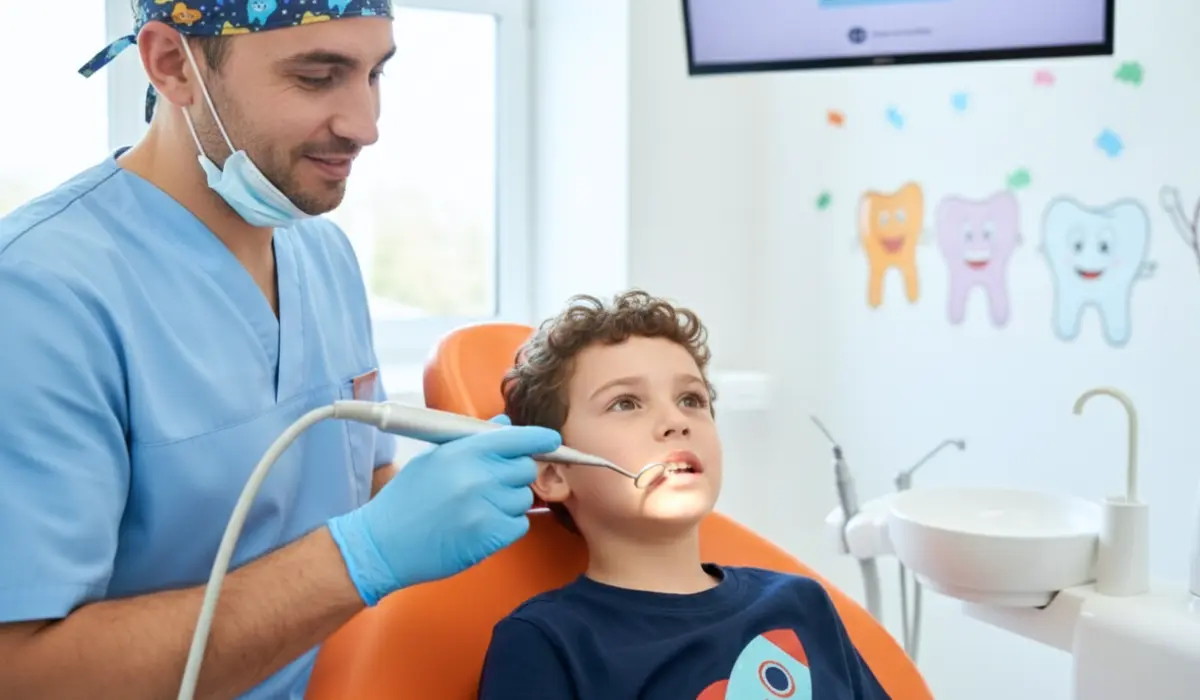
Medically reviewed by Dr. Yury Slepak, DDS – Diplomate, American Board of Pediatric Dentistry | 15+ Years Experience | Last Updated: March 2026
In a pediatric dental emergency, stay calm, assess your child’s injury, and call a pediatric dentist immediately. For a knocked-out permanent tooth, place it in milk and get to the dentist within 30 minutes for the best chance of saving it. For severe pain, give an age-appropriate pain reliever and call for a same-day appointment. For swelling with fever, seek care urgently. Most dental emergencies can be treated successfully when you act quickly and know what steps to take.
Dental emergencies are frightening for both children and parents. Whether your child has fallen and knocked out a tooth, is crying from a sudden toothache, or has a swollen face from infection, knowing what to do in those critical first moments can make a significant difference in the outcome.
What Counts as a Pediatric Dental Emergency?
Not every dental problem requires emergency care, but some situations need immediate attention. Understanding the difference helps you respond appropriately.
Emergencies that require immediate care include:
- A knocked-out permanent tooth needs treatment within 30 minutes to one hour for the best chance of successful reimplantation.
- Severe tooth pain that does not improve with over-the-counter pain medication may indicate infection or significant damage.
- Swelling in the face, jaw, or gums, especially with fever, can signal a serious infection that requires prompt treatment.
- A broken or cracked tooth with exposed nerve tissue causes severe pain and needs same-day care.
- Uncontrolled bleeding from the mouth that does not stop with pressure requires immediate evaluation.
- A tooth that has been pushed into the gum or knocked significantly out of position needs urgent assessment.
Situations that need attention soon but may not be true emergencies include:
- A small chip without pain can typically wait for a regular appointment, though you should call to schedule soon.
- A lost filling or crown should be addressed within a few days to prevent further damage.
- Mild tooth sensitivity may indicate an issue worth monitoring but usually does not require emergency care.
- When in doubt, call your pediatric dentist. They can help you determine whether your child needs to be seen immediately or if the situation can wait.
What to Do If Your Child Knocks Out a Tooth
A knocked-out tooth is one of the most time-sensitive dental emergencies. Your response in the first 30 minutes significantly affects whether the tooth can be saved.
First, determine if it is a baby tooth or permanent tooth.
For baby teeth, do NOT try to put the tooth back in. Reimplanting a baby tooth can damage the permanent tooth developing underneath. Instead, control any bleeding by having your child bite on clean gauze, apply a cold compress to reduce swelling, and call your pediatric dentist for guidance.
For permanent teeth, you may be able to save the tooth if you act quickly.
Steps for a knocked-out permanent tooth:
- Find the tooth immediately. Time is critical.
- Pick up the tooth by the crown only, which is the white part that is normally visible. Never touch the root, as this can damage the cells needed for reattachment.
- If the tooth is dirty, gently rinse it with milk or saline solution. Do not scrub it, use soap, or wrap it in tissue.
- Try to place the tooth back in the socket if possible. Have your child bite down gently on clean gauze or a cloth to hold it in place.
- If you cannot reinsert the tooth, keep it moist. Place it in a cup of cold milk, which preserves the root cells better than water. You can also place it in your child’s saliva by having them hold it gently in their cheek if they are old enough not to swallow it.
- Get to the dentist immediately. The best chance of saving the tooth is within 30 minutes, though reimplantation may still be possible up to an hour or more in some cases.
“Contact us immediately,” advises Dr. Yury Slepak, board-certified pediatric dentist at Bite Squad Dental of NYC. “We prioritize emergencies and aim to see patients within the same day during business hours.”
What to Do If Your Child Chips or Breaks a Tooth
A chipped or broken tooth can range from minor to serious depending on the extent of the damage.
For a small chip with no pain:
- Rinse your child’s mouth with warm water.
- If there are any sharp edges, you can cover them temporarily with dental wax or sugar-free gum to protect the tongue and cheeks.
- Call your dentist to schedule an appointment within the next few days.
For a larger break or a chip with pain:
- Rinse the mouth gently with warm water to clean the area.
- If you can find any broken tooth fragments, save them in milk or water.
- Apply a cold compress to the outside of the cheek to reduce swelling.
- Give your child an age-appropriate pain reliever if needed.
- Call your pediatric dentist for a same-day appointment.
- If the break exposes the inner nerve of the tooth, the tooth may appear pink or red in the center, and your child will likely be in significant pain. This situation requires urgent care to prevent infection and save the tooth.
What to Do for a Severe Toothache
A sudden, severe toothache often indicates a cavity that has reached the nerve, an infection, or an abscess. While you cannot fix the underlying problem at home, you can help your child feel more comfortable until they see the dentist.
Steps to relieve toothache pain temporarily:
- Have your child rinse with warm salt water. Mix about half a teaspoon of salt in eight ounces of warm water. This can help reduce inflammation and may dislodge any food particles that are contributing to discomfort.
- Gently floss around the affected tooth to remove any trapped food.
- Give an age-appropriate dose of children’s ibuprofen or acetaminophen. These can help reduce pain and inflammation.
- Apply a cold compress to the outside of the cheek for 15 to 20 minutes at a time.
What NOT to do:
- Do not apply aspirin directly to the gums. This can burn the tissue.
- Do not apply heat, which can increase swelling if infection is present.
- Do not ignore ongoing tooth pain. Even if the pain comes and goes, it usually indicates a problem that needs treatment.
Call your pediatric dentist as soon as possible. Toothaches rarely resolve on their own and often get worse without treatment.
What to Do If Your Child Has Facial Swelling
Swelling in the face, jaw, or gums is a warning sign that should not be ignored, especially if accompanied by fever. This often indicates a dental abscess, which is an infection that has formed a pocket of pus.
Signs of a dental abscess include:
- Swelling in the cheek, jaw, or around the eye
- Pain that may be severe or throbbing
- Fever
- A small bump on the gums that looks like a pimple
- Bad taste in the mouth
- General feeling of being unwell
What to do:
- Call your pediatric dentist immediately. Dental infections require professional treatment and often antibiotics.
- Apply a cold compress to the outside of the swollen area. Do not apply heat.
- Have your child rinse with mild salt water to help draw infection toward the surface.
- Give age-appropriate pain reliever for comfort.
When to go to the emergency room:
- If swelling is severe and spreading rapidly
- If your child has difficulty breathing or swallowing
- If fever is high and not responding to fever reducers
- If your child appears very ill
Dental infections can become serious if left untreated. Do not wait to see if swelling goes away on its own.
What to Do If Your Child Bites Their Lip, Tongue, or Cheek
Mouth injuries from bites are common in children and usually look worse than they are due to heavy bleeding. The mouth has an excellent blood supply, which means cuts bleed a lot but also heal quickly.
Steps for a mouth bite or cut:
- Apply gentle pressure with clean gauze or a clean cloth. Hold for at least 10 to 15 minutes without checking repeatedly, as this can disrupt clot formation.
- Apply a cold compress to the outside of the mouth to reduce swelling.
- Once bleeding has slowed, rinse gently with cool water.
When to seek care:
- If bleeding does not stop after 15 to 20 minutes of constant pressure
- If the cut is deep or gaping
- If there is debris in the wound that you cannot rinse away
- If the cut is on the face and may leave a visible scar
Most minor mouth injuries heal on their own within a week or two. If your child has bitten through the lip completely or the wound seems deep, they may need stitches.
How to Know If It Is an Emergency or Can Wait
When your child is in pain or injured, it can be hard to judge the severity. Here is a general guide:
Seek care immediately (same day or emergency room):
- Knocked-out permanent tooth
- Severe facial swelling, especially with fever
- Uncontrolled bleeding
- Severe pain that does not respond to pain medication
- Tooth pushed into the gum or significantly displaced
- Signs of difficulty breathing or swallowing
Schedule a same-day appointment if possible:
- Broken or chipped tooth with pain or sharp edges
- Moderate toothache
- Object stuck between teeth causing pain
- Lost filling or crown with discomfort
Can wait 24 to 48 hours:
- Small chip with no pain
- Loose baby tooth that is not causing problems
- Minor sensitivity
When uncertain, call your pediatric dentist. “When you call 718-998-2424, we assess the urgency of the situation and provide immediate assistance,” explains Dr. Slepak. “We can help you determine the right course of action.”
What If the Emergency Happens at Night or on a Weekend?
Dental emergencies do not always happen during business hours. Knowing your options helps you handle after-hours situations.
- During business hours: Call your pediatric dentist for same-day emergency appointments. At Bite Squad Dental, we offer urgent care and prioritize emergencies.
- On weekends: Some pediatric dental offices, including Bite Squad Dental, offer weekend hours. Check your dentist’s availability. We are open Saturday and Sunday for urgent care.
- After hours: If you cannot reach your dentist, manage pain and protect the injury using the steps above until the office opens. For knocked-out permanent teeth, time is critical, so if you cannot reach your dentist, consider going to an emergency room with dental services.
When to go to the emergency room instead of waiting for the dentist:
- Severe facial swelling affecting breathing or swallowing
- Uncontrolled bleeding
- Signs of serious infection with high fever
- Broken jaw or facial bone
- Trauma involving head injury or loss of consciousness
Most dental emergencies can wait a few hours for your pediatric dentist to see them, but the situations above require immediate medical attention.
How to Prevent Pediatric Dental Emergencies
While not all emergencies can be prevented, you can reduce the risk with these strategies.
- Use mouthguards during sports. Custom-fitted mouthguards from your dentist provide the best protection. “We take an impression of the child’s teeth to fabricate a custom guard that fits snugly and provides maximum protection,” notes Dr. Slepak. Mouthguards are essential for contact sports like football, basketball, soccer, and hockey.
- Childproof your home. Secure furniture that could tip, use safety gates, and supervise young children during active play to prevent falls.
- Teach children not to use teeth as tools. Opening packages, chewing on pens, or cracking nuts with teeth can cause chips and breaks.
- Avoid hard foods that cause damage. Ice, hard candy, and popcorn kernels are common culprits for cracked and broken teeth.
- Maintain regular dental checkups. Catching small problems before they become big ones prevents many emergencies. Weak teeth from untreated decay are more likely to break.
Emergency Pediatric Dental Care in Brooklyn
Bite Squad Dental of NYC understands that dental emergencies are stressful. That is why we offer same-day emergency appointments during business hours and are open on weekends for urgent care.
Dr. Yury Slepak is a board-certified pediatric dentist with over 20 years of experience handling dental emergencies in children. He graduated with honors from NYU College of Dentistry and completed his pediatric residency at Maimonides Medical Center.
For children who need emergency treatment and are anxious or require extensive work, we offer sedation options including laughing gas for mild anxiety. For complex cases requiring general anesthesia, Dr. Slepak has hospital privileges at three medical facilities in Brooklyn and Queens.
“We prioritize emergencies and aim to see patients within the same day during business hours,” confirms Dr. Slepak. “We discuss all options to ensure your child’s comfort.”
With over 1,950 five-star Google reviews, Brooklyn families trust Bite Squad Dental for compassionate emergency care.
For dental emergencies, call 718-998-2424 immediately. After hours, leave a voicemail or email bitesquaddental@gmail.com, and we will respond as soon as possible.
FAQs About Pediatric Dental Emergencies
Should I go to the ER or a dentist for a dental emergency?
For most dental emergencies, a pediatric dentist can provide better treatment than an emergency room. ERs can manage pain and infection but typically cannot perform dental procedures like reimplanting teeth or repairing breaks. However, go to the ER if your child has severe facial swelling affecting breathing, uncontrolled bleeding, head trauma, or broken facial bones.
Can a knocked-out baby tooth be saved?
No, baby teeth should not be reimplanted. Putting a baby tooth back in the socket can damage the permanent tooth developing underneath. Control bleeding, apply a cold compress, and contact your dentist for guidance. The permanent tooth will eventually grow in to replace it.
How long can a knocked-out tooth survive outside the mouth?
The best chance of saving a knocked-out permanent tooth is within 30 minutes to one hour. The tooth must be kept moist, ideally in milk or the child’s saliva. After about two hours, the chances of successful reimplantation decrease significantly, but it is still worth trying.
Will my child need sedation for emergency dental treatment?
It depends on the procedure and your child’s anxiety level. Many emergency treatments can be done with local anesthesia (numbing). For anxious children or complex procedures, sedation options are available. “This depends on the procedure. We discuss all options to ensure your child’s comfort,” explains Dr. Slepak.
What if the dental emergency happens at night or on a holiday?
Manage pain with age-appropriate medication, protect the injured area, and contact your dentist first thing when the office opens. For knocked-out permanent teeth, time is critical, so go to an emergency room if you cannot reach a dentist. For severe swelling, high fever, or difficulty breathing, go to the ER immediately.
Does dental insurance cover emergency visits?
Most dental insurance plans cover emergency visits, though coverage varies. Contact your insurance provider for details. Our team at Bite Squad Dental can help verify your benefits.
About the Author
Dr. Yury Slepak is a board-certified pediatric dentist at Bite Squad Dental in Brooklyn who has handled hundreds of pediatric dental emergencies, from knocked-out teeth to severe toothaches. He provides same-day emergency appointments and helps parents navigate urgent dental situations with calm, expert guidance and age-appropriate pain management.
Disclaimer
Medically reviewed by Dr. Yury Slepak, DDS.
This content is for educational purposes only and is not intended as medical advice, diagnosis, or treatment. Please consult a qualified healthcare provider for personalized recommendations.